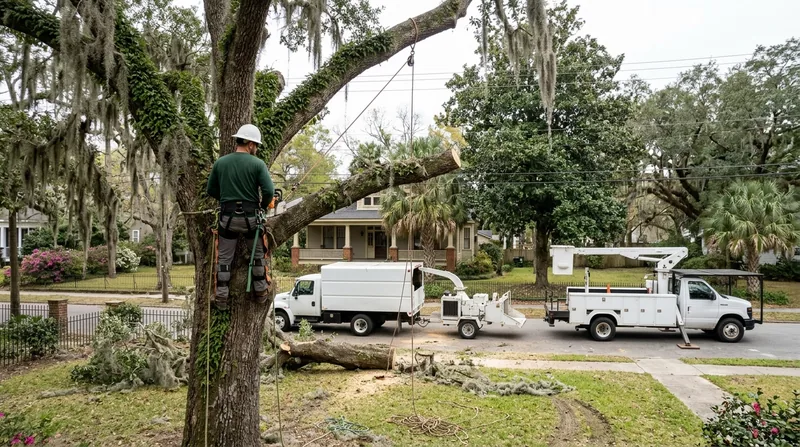




Tree Removal in Savannah demands precision, local knowledge, and respect for the unique urban forest that defines this city. From the massive live oaks draped in Spanish moss that anchor the Historic District squares to the water oaks and southern magnolias scattered across Ardsley Park, Thunderbolt, and the marsh-front properties of Isle of Hope, Savannah's canopy is both an asset and a liability. We remove hazardous, dead, and unwanted trees of any size, handling complex work near historic brick and stucco homes, iron-fenced courtyards, overhead utility lines, and narrow rear lanes where access and precision are everything. Whether you're dealing with a storm-damaged pine in Pooler, a diseased oak threatening your foundation in the Victorian District, or an invasive Chinese tallow encroaching on your Tybee Island cottage, we have the equipment, expertise, and local permitting knowledge to get the job done safely. Our crews understand Savannah's flat, sandy terrain, salt marsh edges, and the tight quarters of historic neighborhoods where a single mistake can damage a neighbor's property or breach a historic district guideline.
Why Tree Removal Matters in Historic and Modern Savannah
Savannah's tree canopy is one of its greatest charms, but aging oaks, storm damage, disease, and structural conflicts with homes and utilities make removal a critical service. A dead or leaning live oak near your 1880s Victorian on East 47th Street or your raised beach cottage on Tybee Island isn't just an eyesore, it's a safety and liability risk. Permits are required in many Savannah neighborhoods for trees above a certain diameter, and heritage tree ordinances protect specific species in the Historic District and other protected zones. HOA rules often govern visible removals, and property line disputes over overhanging limbs require careful, documented work.
- We obtain and understand all local tree removal permits required by Savannah, Pooler, Garden City, and other service area municipalities before any work begins.
- We navigate heritage tree ordinances and protected tree status so your removal stays compliant with city code and historic district guidelines.
- We coordinate with HOAs and provide documentation for visible removals in deed-restricted neighborhoods across Savannah and surrounding areas.
- We handle property line removals and neighbor disputes with clear communication and photographic evidence of the work performed.
Proper removal protects your property investment, your neighbors' safety, and your legal standing in a city where tree ordinances and historic preservation rules carry real weight.
Key info: Savannah and Pooler require permits for trees over 6 inches diameter in many zones; the Historic District enforces heritage tree protections on oaks, magnolias, and other canopy species. We handle all paperwork and coordinate with the city before we cut. See emergency tree service if a storm has already damaged your tree and created an immediate hazard.
How We Remove Trees Safely in Savannah's Tight Urban Environment
Tree removal in Savannah is rarely a straightforward fell and chip operation. Our crews work in dense historic neighborhoods, around power lines that run along streets and rear lanes, near iron fences and walled gardens, and on properties where a single limb can damage a neighbor's home or roof. We assess every job on-site, plan the rigging, and deploy the right equipment, whether that's a bucket truck for a tall slash pine in Garden City, a crane for a massive live oak near a 1790s brick Federal townhouse, or hand-felling and sectional rigging for a crape myrtle in a tight rear courtyard on Whitemarsh Island.
- We perform a detailed site inspection to map utility lines, property lines, nearby structures, and access constraints before quoting or scheduling.
- We use bucket trucks, cranes, rigging, and hand techniques tailored to the tree size, species, location, and proximity to homes, fences, and power lines.
- We chip or haul all debris, leaving your property clean and ready for stump grinding or landscaping work.
- We coordinate with utility companies if power lines or cable runs cross or overhang the removal zone.
Every removal is planned for safety, efficiency, and respect for your property and your neighbors' rights.
Example: A 60-foot live oak in the courtyard of a 1880s Italianate home on Forsyth Park in Savannah required sectional rigging and hand-lowering of each piece to avoid damaging the wrought-iron fence and brick walls. A large pine threatening a raised home on Isle of Hope was removed with a crane positioned on the marsh side. Both jobs were planned in detail and executed without incident or damage.
Tree Removal Methods: Choosing the Right Approach for Your Savannah Property
| Approach | Description | Best for |
|---|---|---|
| Bucket Truck Removal | We use an aerial bucket truck to access and dismantle the tree from the top down, lowering large sections to the ground or chipping them in place. | Medium to large trees in open yards, street trees in Savannah neighborhoods with clear overhead space, and trees near power lines where we need precise control. |
| Crane Removal | A mobile crane lifts large sections or the entire tree, allowing us to remove massive oaks and pines without rigging or sectional dismantling. | Large heritage live oaks, storm-damaged trees with unstable lean, removal near homes or fences where rigging poses risk, and jobs where speed and precision are critical. |
| Sectional Rigging | Our crews hand-lower each section using rope and pulley systems, ideal for tight urban spaces and historic properties where equipment access is limited. | Trees in walled courtyards, historic neighborhoods, rear yards on Tybee Island or Isle of Hope, and removal near historic structures where damage risk is high. |
| Directional Felling | For trees in open space, we fell the tree in a controlled direction and process it on the ground, minimizing equipment and cost. | Smaller trees, dead trees in open yards, land clearing projects, and removal in rural or suburban Savannah properties with ample space. |
We assess access, tree condition, site constraints, and your budget to recommend the most cost-effective and safest method for your specific removal.
Tree Removal Cost in Savannah: What to Expect
Tree removal pricing in Savannah depends on several factors specific to your property and tree. A free estimate is the only honest starting point, because the cost of removing a 30-foot crape myrtle in an open Southside yard is vastly different from removing a 70-foot live oak near a historic home or removing multiple trees during land clearing in Pooler. We assess tree size (measured in diameter and height), species, proximity to structures and utilities, access for equipment, and the complexity of rigging or crane work on-site before we quote a price.
Most residential removals in Savannah range from $500 to $3,000 for a single tree, depending on size and access. Larger heritage oaks, storm-damaged trees requiring crane work, or multiple removals will cost more. The best way to understand your cost is to call us at (912) 468-0839 for a free estimate. We'll visit your property, measure the tree, assess the work, and provide a firm quote with no obligation. Getting 2-3 estimates from insured contractors is smart practice, so you can compare method, equipment, debris handling, and total cost before you decide.
Visit our pricing overview for more detail on what affects cost and what's included in a typical removal job. If you need emergency removal after a storm, expect faster response and potentially premium pricing, but we prioritize hazard trees quickly.
What to Look for When Hiring a Tree Service Near Savannah
Savannah homeowners should verify three essentials before hiring any tree removal contractor: licensing, insurance, and local knowledge. A fully insured tree service carries general liability and workers compensation, protecting you if an accident or property damage occurs during the job. Ask to see current certificates and verify coverage limits. Local knowledge matters because Savannah's permitting rules, heritage tree ordinances, HOA requirements, and tight urban layout require crews who understand the city's specific constraints.
- Confirm the contractor is insured with current general liability and workers compensation coverage.
- Ask for at least three references from recent removals in Savannah, Pooler, or nearby areas, and call them to verify quality and professionalism.
- Request a written estimate that includes tree size, method, debris removal, equipment used, and a firm price with no hidden charges.
- Verify that the contractor understands local permit requirements and will obtain permits on your behalf before any work begins.
- Check whether your HOA or historic district requires approval for visible removals, and confirm the contractor can navigate that process.
A reputable contractor will answer questions patiently, provide references, and never pressure you into a same-day decision. Contact us at (912) 468-0839 or visit our contact page to request a free estimate and discuss your removal needs with a local Savannah tree service professional.
Tree Removal in Savannah: Pricing Guide
| Service | Price | Details |
|---|---|---|
| Small tree removal | Starting at $500 | Trees up to 30 feet tall, open access, standard species like crape myrtle or smaller oak |
| Medium to large tree removal | Starting at $1,200 | Trees 30-60 feet, moderate access constraints, bucket truck or rigging required near structures |
| Heritage oak or complex removal | On estimate | Large live oaks, proximity to historic homes or power lines, crane work, multiple trees, or land clearing |
| Free estimate | No cost, no obligation | On-site inspection, tree measurement, method assessment, written quote within 24 hours |
| Travel | Included | No separate mileage or call-out fee in Savannah, Pooler, Garden City, and surrounding service areas |
| Debris removal and cleanup | Included | Chipping, hauling, and site cleanup are part of the removal price, property left clean and ready |
Indicative pricing, the exact cost depends on square footage, finish, and site access. Free personalized estimate within 24h at (912) 468-0839.


